Family, Memory, and the Haunted American South #
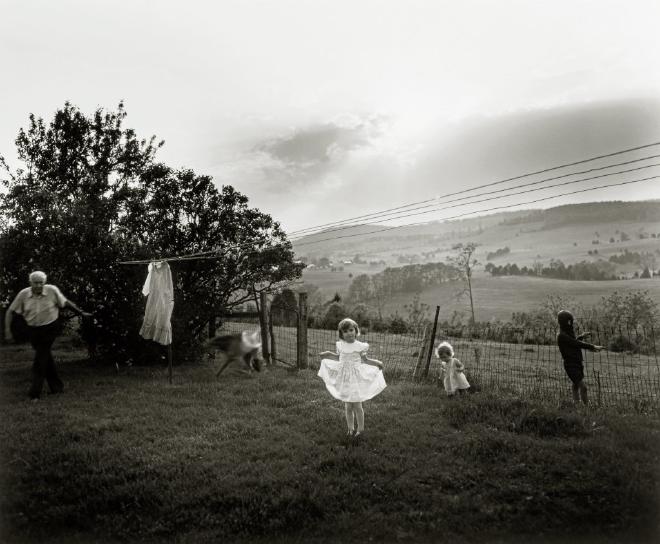
Welcome back, Photo Nerds. Let’s talk about Sally Mann.
Who Is Sally Mann? #
Sally Mann (born 1951) is one of America’s most celebrated—and controversial—photographers. Working primarily with large-format cameras and traditional photographic processes, Mann has spent more than four decades exploring themes of family, memory, mortality, landscape, history, and the passage of time.
Raised and still living in Lexington, Virginia, Mann’s work is inseparable from the American South. Whether photographing her children, Civil War battlefields, her husband, or the Southern landscape itself, she creates images that are simultaneously intimate, lyrical, and unsettling.
Her photographs are unmistakable: luminous black-and-white prints rich in texture, imperfection, and atmosphere. Rather than chasing technical perfection, Mann often embraces antique lenses, wet-plate collodion processes, and photographic flaws that lend her work an almost timeless quality.
Beauty and Unease #
Few photographers have explored the overlap between beauty and discomfort as profoundly as Sally Mann.
Her work repeatedly asks viewers to consider:
- childhood and innocence
- mortality
- family relationships
- memory
- race and history
- the Southern landscape
- decay and the passage of time
Rather than providing answers, Mann invites us to sit with ambiguity. Her photographs often feel like fragments of dreams—or memories that become less certain the longer we examine them.
Major Bodies of Work #
At Twelve (1988) #
Mann’s first widely acclaimed project, At Twelve, consists of portraits of girls on the threshold between childhood and adulthood.
Rather than sentimentalizing adolescence, Mann presents it as awkward, uncertain, vulnerable, and deeply human.
Many critics consider this one of the finest photographic studies of adolescence ever published.
Immediate Family (1992) #
Perhaps the most famous—and controversial—photography book of the 1990s.
The series depicts Mann’s three young children growing up on their family farm in Virginia.
The photographs range from playful and joyful to mysterious and haunting. Some include childhood nudity, sparking intense public debate about privacy, art, and exploitation.
Today, Immediate Family is widely regarded as one of the most influential photobooks ever published, even as discussions surrounding it continue.
What Remains (2003) #
This deeply personal project examines death from multiple perspectives.
The work includes:
- decomposing animal remains
- Civil War battlefields
- forensic anthropology (“body farm”) studies
- the site where an escaped convict died on Mann’s property
Rather than being macabre for its own sake, What Remains meditates on impermanence and the physical reality of mortality.
Deep South (2005) #
Moving away from portraiture, Mann photographed the Southern landscape using nineteenth-century wet-plate collodion techniques.
These misty, dreamlike images evoke history, memory, slavery, the Civil War, and the lingering psychological landscape of the American South.
The photographs feel less like documents than ghosts.
Proud Flesh (2009) #
One of Mann’s most intimate series documents her husband Larry after he developed muscular dystrophy.
The photographs are tender rather than tragic, exploring aging, vulnerability, love, and devotion.
Many critics consider this among her most emotionally mature bodies of work.
Sally Mann’s Most Famous Photographs #
Although Mann is best known for complete bodies of work, several individual photographs have become iconic.
1. Candy Cigarette (1989) #
Arguably her most recognizable image.
Jessie Mann stands confidently holding a candy cigarette while her younger siblings drift into the background.
The photograph beautifully captures childhood’s uneasy balance between innocence and adulthood.
2. The Perfect Tomato (1990) #
One of the signature photographs from Immediate Family.
Jessie dances nude atop a picnic table while holding a tomato.
The image became central to debates surrounding the series and remains one of Mann’s most discussed photographs.
3. Damaged Child (1984) #
Virginia Mann stares directly into the camera with one eye swollen after an insect bite.
The image is both unsettling and profoundly compassionate.
It has become one of Mann’s defining portraits.
4. Jessie at Five (1987) #
A remarkably poised portrait that reveals Mann’s extraordinary ability to photograph children as psychologically complex individuals rather than sentimental subjects.
5. Deep South #32 (from Deep South) #
One of her haunting Southern landscapes created with the wet-plate collodion process.
The blurred trees, dark skies, and antique process combine to produce an image that feels suspended outside time.
Books by Sally Mann #
Few photographers have published as many influential books.
Recommended reading includes:
Essential Photography Books #
- Second Sight (1983)
- At Twelve (1988)
- Immediate Family (1992)
- Still Time (1994)
- What Remains (2003)
- Deep South (2005)
- Proud Flesh (2009)
- The Flesh and The Spirit (2010)
- Southern Landscape (2013)
- Remembered Light: Cy Twombly in Lexington (2016)
- Sally Mann: A Thousand Crossings (2018)
- Art Work (2025)
Memoir #
Hold Still: A Memoir with Photographs (2015)
Widely considered one of the finest artist memoirs ever written, Hold Still intertwines family history, autobiography, and photography. It was a finalist for the National Book Award and won the Andrew Carnegie Medal for Excellence in Nonfiction. Even if you’ve never seen Mann’s photographs, this book is highly recommended.
Documentaries About Sally Mann #
What Remains: The Life and Work of Sally Mann (2005) #
Highly Recommended
An 80-minute HBO documentary directed by Steven Cantor.
The film explores Mann’s family life, creative process, and the making of What Remains.
It was nominated for an Emmy Award.
Reference: https://en.wikipedia.org/wiki/What_Remains:_The_Life_and_Work_of_Sally_Mann
Blood Ties: The Life and Work of Sally Mann (1994) #
A 30-minute documentary produced during the Immediate Family controversy.
Nominated for the Academy Award for Best Documentary Short Subject.
Often considered the best introduction to Mann’s early work.
Excellent Free Videos (YouTube) #
Several outstanding talks and short films are freely available:
- Sally Mann: Collodion and the Angel of Uncertainty (National Gallery of Art)
- Picturing the South: Sally Mann (High Museum of Art)
- Reading from Hold Still (National Gallery of Art)
- Art21: Sally Mann (PBS segment)
These can all be found by searching their titles on YouTube and are excellent companions for a book club meeting.
Why Sally Mann Matters #
Sally Mann’s photographs challenge us to reconsider what photography can accomplish.
Her work demonstrates that photographs can be:
- autobiographical
- historical
- poetic
- unsettling
- beautiful
- ethically complicated
She reminds us that photography isn’t merely about recording appearances—it can explore memory, grief, love, identity, and the complicated histories embedded in people and places.
Few photographers have so successfully combined technical mastery with emotional depth.
“Photographs open doors into the past, but they also allow a look into the future.” — Sally Mann