Beauty, Destruction, and the American Landscape #
Welcome back, Photo Nerds. Today we’re discussing Richard Misrach, an inspiring American photographer.
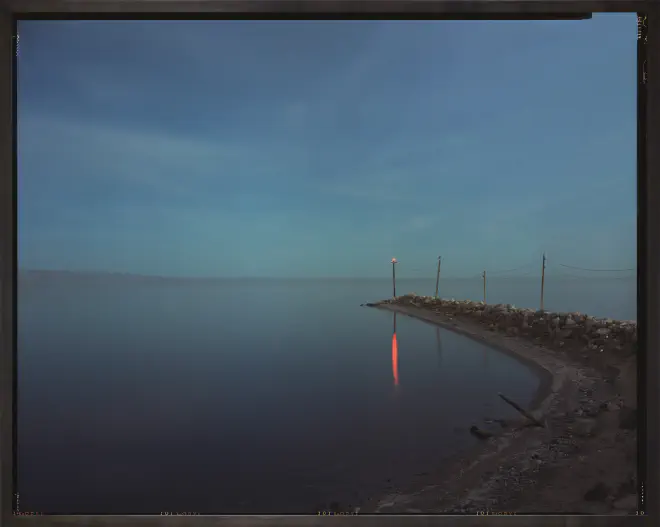
Richard Misrach was born in Los Angeles, California, in 1949 and grew up in the affluent neighborhood of Westwood. In 1967, he enrolled at the University of California, Berkeley, where he encountered the protests and political upheaval surrounding the Vietnam War.
“Berkeley was going through tremendous upheaval,” Misrach recalls. “I’ve never grown as quickly as I did in that year; it sent me on a spiral of challenging a lot of the values my parents held.”
It was at Berkeley that Misrach fell in love with photography. Dorothea Lange and Walker Evans, whose documentary photographs of Depression-era America had brought attention to the lives of the nation’s downtrodden, became his role models.
Inspired by a dream in which the faces of people living on Berkeley’s streets appeared and disappeared, Misrach began photographing the city’s homeless and countercultural communities. This work led to his first book, Telegraph 3 A.M. (1974). The resulting black-and-white photographs of young people struggling with poverty, addiction, and alienation were stark, intimate, and often depressing.
Misrach would later question whether the project had accomplished what he hoped.
“In the end I didn’t really do anything that affected social change, and my art wasn’t particularly great art,” he says. “I came out with this coffee table book that had the greatest intentions yet somehow fell flat.”
Nevertheless, at the age of 24, Misrach abandoned his graduate studies in psychology to pursue photography full-time.
Discovering the Desert #
Misrach’s interests soon turned away from people and toward the vast expanses of the American West.
Traveling through Southern California, Nevada, and Arizona in a Volkswagen van, he camped in remote locations and photographed landscapes almost entirely devoid of human presence.
Working primarily at dawn, dusk, and night, Misrach began experimenting with artificial illumination, using flash and other light sources to transform the desert into something mysterious and unfamiliar.
He described twilight as “the crack between two worlds.”
This early work was radically different from the landscape photography of Ansel Adams, whose carefully rendered black-and-white images celebrated the grandeur of the American wilderness.
Misrach recalled that he was deliberately rebelling against that tradition. Rather than waiting for ideal natural light, he described his approach as a kind of photographic vandalism, using artificial illumination to disrupt conventional ideas of landscape beauty.
The resulting photographs, later collected in Richard Misrach: Night Photographs (2001), are haunting and otherworldly. Cacti, desert vegetation, and isolated structures emerge from darkness under unnatural illumination.
His work began appearing in group exhibitions, and in 1975 he received his first solo exhibition at the International Center of Photography in New York.
Misrach described the experience as “brutal.” After driving across the country for the opening, he reportedly arrived to find no one there.
Recognition would come, but not immediately.
Desert Cantos: A Lifelong Investigation #
In 1979, Misrach began what would become the defining project of his career: Desert Cantos.
Inspired in part by the structure of Dante’s Divine Comedy and Ezra Pound’s The Cantos, the project is organized into individual chapters, or cantos, each exploring a different aspect of the desert.
Working with a large-format Deardorff 8×10-inch view camera, Misrach began producing extraordinarily detailed color photographs of the American Southwest.
The project would eventually grow to encompass dozens of distinct but interconnected bodies of work, ranging from the sublime beauty of seemingly untouched landscapes to the disturbing consequences of human intervention.
Some cantos contain only a handful of photographs; others comprise hundreds of images. Their approaches vary considerably: some are documentary, others metaphorical, aesthetic, conceptual, or explicitly political.
What unites them is Misrach’s fascination with the relationship between humanity and the natural world.
What makes Misrach’s photography so extraordinary, however, is not simply what he chooses to photograph, but how he photographs it. He is a master of color, light, and scale, transforming seemingly ordinary or devastated landscapes into images of astonishing beauty. His use of the large-format camera produces extraordinary detail, while his sensitivity to the changing qualities of natural light gives his photographs an almost painterly atmosphere. The immense scale of his landscapes can make the human presence seem insignificant, even as the evidence of humanity’s destructive influence becomes impossible to ignore. There is something profoundly sublime about his work: the desert stretches toward infinity, mountains dissolve into atmospheric haze, and the most unlikely subjects glow with unexpected color. Yet this beauty is rarely innocent. A brilliant sunset may illuminate a contaminated landscape; an elegant composition may conceal the scars of military bombardment. It is this tension between the beautiful and the disturbing that makes Misrach’s photographs so powerful. He draws us in through their visual splendor, then asks us to confront the uncomfortable realities they reveal. Rather than allowing beauty and political commentary to compete, Misrach makes each more compelling through the presence of the other.
By the early 1980s, Misrach had married and become a father. His growing reputation earned him a Guggenheim Fellowship, which supported work in Greece, where he photographed ancient ruins, including the Parthenon.
Fatherhood also sharpened his awareness of the future and the environmental consequences of human activity.
“I became very future-conscious once my kid was born,” he recalls.
Returning to the desert, he increasingly noticed evidence of humanity’s destructive relationship with nature: animal carcasses, toxic waste, military installations, fires, floods, and abandoned industrial sites.
These discoveries gave his photography a new purpose.
“I felt like I’d developed a language and now I had something to say.”
The Early Cantos: Fire, Flood, and the Sublime #
The earliest Desert Cantos explored elemental forces and the often uneasy relationship between natural beauty and destruction.
Among them were The Terrain, The Event, The Flood, and The Fires, collected in the 1987 book Desert Cantos.
The photographs are often visually spectacular, yet their beauty conceals something more troubling.
A desert fire might initially appear as an extraordinary display of color and light. A flooded landscape might resemble an ancient inland sea. Only after closer examination—or after reading the accompanying context—does the viewer begin to understand the ecological implications.
This tension between beauty and destruction would become one of the defining characteristics of Misrach’s work.
Desert Seas: The Salton Sea #
Among the most memorable chapters of Desert Cantos are Misrach’s photographs of the Salton Sea in Southern California.
Created accidentally in the early twentieth century when Colorado River floodwaters entered the Salton Sink, the sea eventually became a popular recreational destination.
But agricultural runoff, increasing salinity, and ecological deterioration transformed it into a landscape of environmental distress.
Misrach photographed abandoned buildings, deteriorating structures, dead fish, and eerily beautiful stretches of water.
These images are particularly powerful because they initially resemble traditional landscape photographs. The colors are extraordinary, the compositions elegant, and the light almost supernatural.
Yet the beauty is deceptive.
The Salton Sea becomes a metaphor for humanity’s ability to transform a landscape without fully understanding—or accepting responsibility for—the consequences.
Bravo 20: The Bombing of the American West #
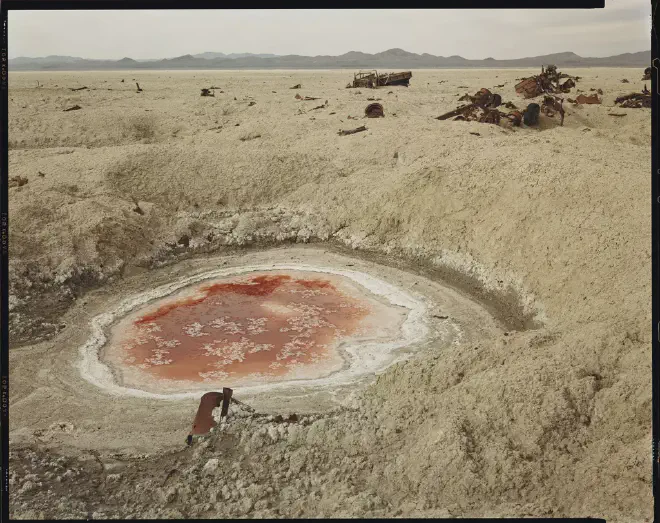
One of the most explicitly political chapters of Desert Cantos emerged from Misrach’s investigation of a military bombing range in Nevada.
Known as Bravo 20, the area was part of the Carson Sink desert, public land that the United States Navy had used for aerial bombing exercises for decades.
The story of Bravo 20, however, begins before Misrach arrived.
Local activists Dick Holmes and Doc Bargen had already been investigating the Navy’s use of the land, uncovering evidence of unauthorized bombing and bringing attention to the environmental destruction it had caused.
Their disclosures ultimately forced the issue into the national political arena. According to a November 1990 Los Angeles Times article by Sean Elder, the Navy acknowledged during a congressional hearing in 1985 that it had illegally bombed the land. Rather than relinquishing control, the Navy subsequently sought to have the area permanently withdrawn from public use.
In November 1986, Bravo 20 was withdrawn from public use until 2001, leaving its long-term fate unresolved.
Misrach entered this story in June 1986, when he ventured into the bombing range with his German shepherd, Kodak, and his 8×10-inch view camera.
The landscape was extraordinarily dangerous. Unexploded bombs littered the desert, some partially buried in the earth. Others had faded markings that made it difficult to distinguish live explosives from practice ordnance.
Nevertheless, Misrach returned repeatedly to photograph the destruction.
His images documented bomb craters, unexploded ordnance, shattered military vehicles, and the scattered remnants of weapons. In one particularly surreal scene, a burned-out school bus sat abandoned in the desert, its interior charred black.
Unlike traditional war photography, there are no soldiers in combat and no dramatic battlefield confrontations.
Instead, Misrach photographed what remained after the violence.
The resulting images are often deceptively beautiful. Vast desert expanses stretch toward distant mountains, interrupted by evidence of destruction that might initially escape the viewer’s attention.
Published in Bravo 20: The Bombing of the American West (1990), the project combined photography with environmental investigation and advocacy. The book included a history of the bombing range written by Misrach’s wife, Myriam Weisang Misrach, as well as his own provocative proposal to transform the devastated landscape into a national park commemorating the destruction.
His proposal was deliberately satirical, envisioning attractions such as a boardwalk of bombs and a driving tour through the devastation.
It was an absurd proposition intended to expose an even greater absurdity: that public land could be systematically destroyed in the name of national defense.
The activism of Holmes and Bargen had helped bring the Navy’s activities to light. Misrach’s contribution was to make the consequences visible to a much wider audience, using the extraordinary beauty and precision of his photographs to transform a regional environmental controversy into a powerful artistic and political statement.
Bravo 20 demonstrated how landscape photography could become a form of testimony.
Misrach was no longer merely photographing the desert. He was asking who controlled it, what was being done to it, and who would ultimately bear the consequences.
Violent Legacies: The Hidden Costs of American Power #
Misrach continued exploring the darker aspects of the American landscape in Violent Legacies: Three Cantos (1992).
The book brought together three chapters of Desert Cantos: The Pit, Project W-47 (The Secret), and The Playboys.
These photographs examined disturbing subjects, including the disposal of dead animals, the legacy of military and nuclear activity, and the strange remnants of human occupation in the desert.
In The Pit, Misrach photographed animal carcasses in a mass burial site, transforming a scene of death and neglect into an image of almost unbearable visual complexity.
Such photographs raised an uncomfortable question that would follow Misrach throughout his career:
Can a photograph be beautiful and horrifying at the same time?
For Misrach, the answer appears to be yes. Indeed, that contradiction is often what gives his photographs their power.
Beyond the Desert: Golden Gate and the Pacific #
During the 1990s, Misrach began expanding his investigations beyond the American Southwest.
In 1997, he started photographing the Golden Gate Bridge and San Francisco Bay from a fixed vantage point, returning repeatedly as weather, light, and atmosphere transformed the scene.
The resulting photographs, published in Richard Misrach: Golden Gate (2001), are almost painterly.
The bridge sometimes appears sharply defined against brilliant skies. At other times it nearly disappears into fog, rain, or atmospheric haze.
The series recalls the work of painters such as Claude Monet and J. M. W. Turner, who explored how changing light could transform a familiar subject.
Although less overtly political than Bravo 20, these photographs demonstrate an equally important aspect of Misrach’s artistic vision: his willingness to study a single place over time, allowing subtle variations in light and atmosphere to become the subject.
Around the same period, Misrach’s The Sky Book (2000) further demonstrated his fascination with the expressive possibilities of light, color, and abstraction.
These quieter projects are important reminders that his work cannot be reduced to environmental advocacy. The sheer experience of looking—the pleasure, mystery, and emotional force of light and color—remained fundamental to his art.
On the Beach: Humanity Seen from Above #
Following the attacks of September 11, 2001, Misrach began photographing people on beaches in Hawaii from elevated vantage points.
Published as On the Beach (2007), the resulting photographs depict swimmers, sunbathers, and isolated human figures suspended in immense expanses of turquoise water and pale sand.
Seen from above, people become remarkably small and vulnerable.
Some images appear serene and inviting. Others suggest isolation, uncertainty, or danger.
The series takes its title from Nevil Shute’s 1957 post-apocalyptic novel, On the Beach, in which humanity confronts the aftermath of nuclear catastrophe.
The reference adds a darker dimension to photographs that might otherwise appear purely idyllic.
Once again, Misrach uses beauty to invite the viewer into a more complicated meditation on humanity’s place in the world.
Hurricane Katrina: Destroy This Memory #
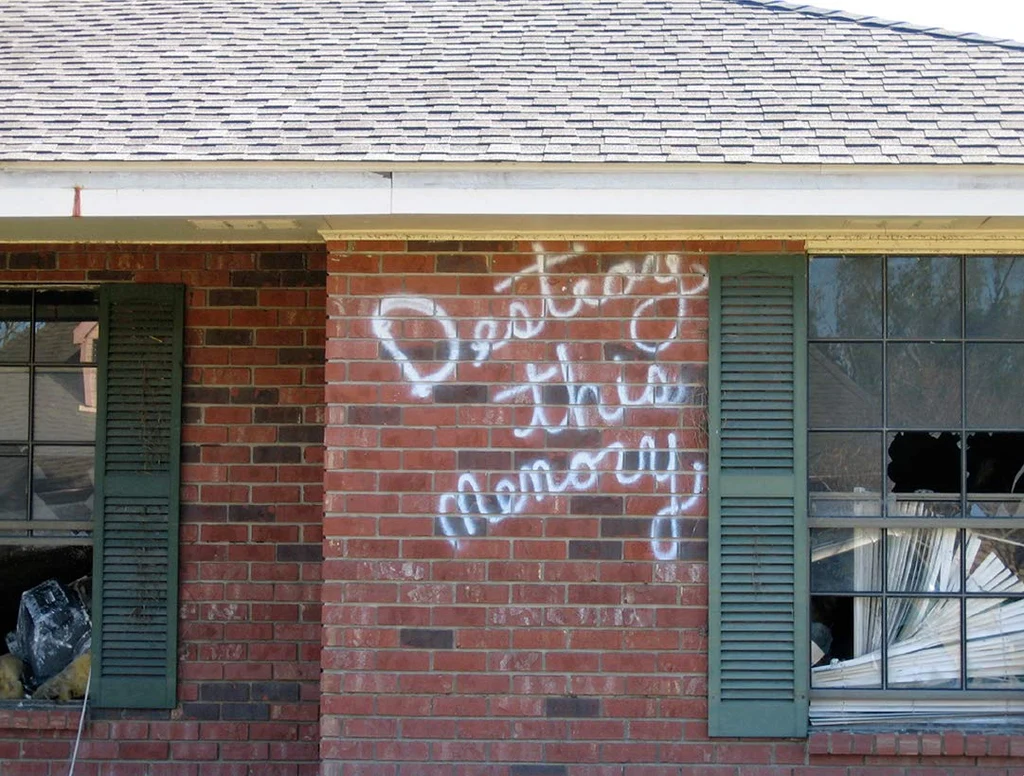
When Hurricane Katrina devastated New Orleans and the Gulf Coast in 2005, Misrach traveled to the region to document its aftermath.
Rather than photographing the destruction in the conventional manner of a photojournalist, he concentrated on the handwritten messages left on damaged buildings, vehicles, and walls.
These messages ranged from desperate pleas for help to warnings, expressions of anger, grief, and dark humor.
The resulting project, Destroy This Memory (2010), represented a significant departure from his monumental large-format landscapes.
Working with a small digital camera, Misrach photographed the words people had left behind.
The images became a collective portrait of a community confronting catastrophe, abandonment, and the failures of institutions entrusted with its protection.
The title itself suggests a paradox: the desire to forget trauma and the equally powerful need to remember it.
Where Bravo 20 documented damage to the landscape, Destroy This Memory recorded the human voices left in the aftermath of disaster.
Petrochemical America: The Industrial Landscape #
Misrach’s investigation of environmental destruction reached another important milestone with Petrochemical America (2012), a collaboration with landscape architect Kate Orff.
The project grew out of photographs Misrach had begun making in 1998 along the Mississippi River between Baton Rouge and New Orleans, an industrial corridor frequently called Cancer Alley.
The region is home to a dense concentration of petrochemical facilities, refineries, and communities living in their shadow.
Misrach’s photographs reveal an unsettling coexistence of natural beauty, industrial infrastructure, and residential life.
Factories rise above wetlands. Pipelines cross fragile landscapes. Churches, homes, and cemeteries sit near sprawling industrial complexes.
Orff’s accompanying research and visualizations expand the photographs into an investigation of environmental history, public health, and industrial systems.
Petrochemical America is among Misrach’s most ambitious works because it demonstrates how photography, research, and design can work together to reveal problems that are difficult to comprehend through images alone.
It also represents a continuation of the concerns that first emerged in Desert Cantos: the environmental consequences of human ambition and the often invisible systems that shape the landscape.
Border Cantos: Walls, Migration, and the Divided Landscape #
Beginning in 2004, Misrach turned his attention to the border between the United States and Mexico.
Over the following years, he photographed the landscape, border infrastructure, discarded belongings, and evidence of people attempting to cross one of the world’s most politically contested boundaries.
The resulting project, Border Cantos (2016), was created in collaboration with composer and artist Guillermo Galindo.
Misrach’s photographs reveal a landscape transformed by surveillance, fences, walls, and the movement of people.
Some images are monumental: border barriers stretch across deserts and mountains, dividing landscapes that otherwise appear continuous.
Others are intimate, focusing on abandoned clothing, water containers, backpacks, and personal possessions.
Galindo transformed objects recovered from the borderlands into musical instruments, creating compositions that give these remnants another form of expression.
Together, their work explores the border as both a physical structure and a symbol of political division, migration, identity, and human vulnerability.
In many ways, Border Cantos brings Misrach’s career full circle.
Like Telegraph 3 A.M., it is concerned with people whose lives are shaped by powerful social and political forces. But instead of photographing their faces directly, Misrach often reveals their presence through the landscapes and objects they leave behind.
Premonitions: The Writing on the Wall #
Misrach’s exploration of the political landscape continued with Premonitions and The Writing on the Wall, shown in 2017.
These photographs examine graffiti and messages appearing on abandoned structures and walls in the American Southwest and Southern California.
The messages, often angry, anxious, or prophetic, reflect the political tensions surrounding the 2016 presidential election and the uncertainty of the period that followed.
Like Destroy This Memory, the work allows anonymous voices to enter the landscape.
Misrach becomes a witness to words written by others, preserving expressions of fear, frustration, and resistance that might otherwise disappear.
The photographs also demonstrate the continuing flexibility of Desert Cantos, a project capable of responding to changing political circumstances without abandoning its central concerns.
Cargo: The Invisible Machinery of Globalization #
Misrach’s recent series Cargo, begun in 2021 and published by Aperture in 2025, returns to San Francisco Bay.
Photographing cargo ships traveling to and from the Port of Oakland, Misrach once again studies a familiar landscape from a relatively fixed vantage point.
The photographs are extraordinary studies of light, weather, color, and atmosphere.
Massive container ships emerge from fog, disappear into brilliant sunsets, or sit quietly against the enormous expanse of sea and sky.
At first glance, they resemble the romantic maritime paintings of Turner.
But these vessels represent something much larger than the beauty of the ocean.
They are essential components of global trade, carrying the manufactured goods and raw materials upon which modern consumer economies depend.
Their presence raises questions about globalization, consumption, labor, and the environmental consequences of international shipping.
What makes Cargo especially compelling is that Misrach does not need to photograph an obvious environmental catastrophe to make his point.
The ships are ordinary, ubiquitous, and easily overlooked.
By rendering them beautiful, he asks us to notice something we have learned not to see.
It is a fitting continuation of a career devoted to revealing the complicated relationship between human civilization and the natural world.
A Lifetime of Looking #
Over more than five decades, Richard Misrach has developed one of the most distinctive bodies of work in contemporary photography.
From the troubled young people of Berkeley to the deserts of the American West, from military bombing ranges to hurricane-ravaged neighborhoods, from the border wall to the cargo ships crossing San Francisco Bay, his photographs repeatedly return to a fundamental question:
What does the way we treat the landscape reveal about who we are?
Desert Cantos remains the centerpiece of his career, an extraordinary project that has evolved alongside the photographer himself.
But his later work demonstrates that Misrach’s concerns have never been limited to the desert.
He is interested in the systems, histories, and human decisions that shape the places we inhabit.
His photographs are often beautiful enough to be mistaken for celebrations of the natural world. Look more closely, however, and that beauty frequently reveals something disturbing.
Perhaps that is Misrach’s greatest achievement.
He invites us to admire the world—and then challenges us to confront what we are doing to it.
Sources and Further Reading #
- Sean Elder, “The Tainted Desert: Richard Misrach’s Photographs Document the Beauty and Ruin of the American West”, Los Angeles Times, November 4, 1990.
- “An Archival Interview with Richard Misrach”, Aperture. Misrach discusses the structure and meaning of Desert Cantos.
- “Richard Misrach on Border Cantos”, Aperture, October 21, 2015.
- Richard Misrach: Cargo, Aperture, 2025.
- Richard Misrach bibliography and exhibition history, Fraenkel Gallery.