Photographer, Filmmaker, Storyteller, Activist #
Gordon Parks occupies a remarkable place in American photography. He was a photographer, filmmaker, novelist, composer, and an artist who refused to let the circumstances of his birth define the limits of his ambition. Born in Fort Scott, Kansas, in 1912, Parks grew up in a segregated America and understood firsthand the injustices he would spend much of his career documenting.
He famously described the camera as his choice of weapon against poverty and racism. But what strikes me most about Parks is that his photographs are never only about injustice. They are about people—their dignity, vulnerability, resilience, and humanity.
American Gothic #
In 1942, while working for the Farm Security Administration in Washington, D.C., Parks photographed Ella Watson, a Black cleaning woman, standing before an American flag with a mop and broom. He titled the photograph American Gothic, a pointed reference to Grant Wood’s familiar painting.
It’s a deceptively simple image. The flag promises liberty and equality; Watson’s expression and the tools of her labor tell a more complicated story. Parks had experienced segregation in Washington himself, and this photograph turned that experience into an unforgettable visual statement.
Yet Parks did not stop at the symbolic portrait. He also photographed Watson’s family and daily life, giving viewers a fuller understanding of the woman behind the image.
Harlem Gang Leader #
In 1948, Parks became the first Black staff photographer at Life magazine. One of his earliest major assignments followed Leonard “Red” Jackson, a young Harlem gang leader.
Rather than sensationalizing violence or reducing Jackson to a stereotype, Parks photographed him as a person navigating a difficult world. The pictures are intimate, cinematic, and often surprisingly tender.
This is one of the qualities I admire most about Parks: his ability to gain a subject’s trust and tell a story from within, rather than simply looking in from the outside.
Segregation Story #
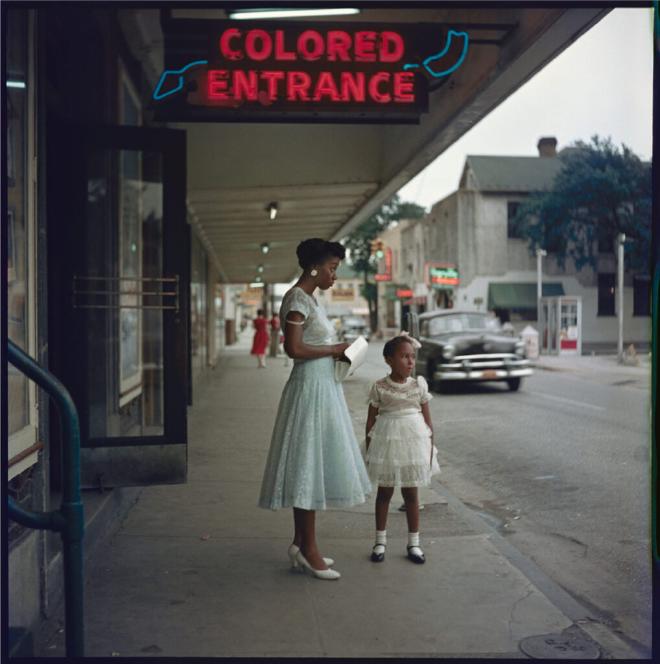
Parks’s 1956 photographs of Black families in Alabama are among his most extraordinary works. Often referred to as Segregation Story, the series documents ordinary moments—children playing, families shopping, people going about their lives—under the indignities of Jim Crow.
The use of color is particularly striking. The photographs are beautiful, sometimes almost painterly, and that beauty makes the reality of segregation all the more unsettling. A family dressed for an outing or children standing near a segregated entrance becomes a quiet but powerful indictment of the society around them.
Many images from this series received renewed attention decades later, reminding us that Parks was not only an important witness to history, but an exceptionally gifted color photographer.
Beyond the News Photograph #
During his years at Life, Parks photographed poverty, fashion, civil rights leaders, entertainers, and athletes, including Malcolm X and Muhammad Ali. His range was astonishing.
He understood that photographs could do more than illustrate a news story. Through sequencing, gesture, light, and composition, he could build an emotional narrative—something closer to a short story told in pictures.
And he was no stranger to elegance. His fashion photographs demonstrate the same command of light and form as his documentary work. Parks never seemed to believe that artistic beauty and social purpose had to be mutually exclusive.
The Learning Tree and Hollywood #
Parks carried that storytelling instinct into literature and film. His semi-autobiographical novel The Learning Tree became a film in 1969, which he wrote and directed. It marked a major breakthrough for Black filmmakers working within Hollywood’s studio system.
Two years later he directed Shaft (1971), a landmark of American popular cinema.
It’s worth remembering that Parks did not simply move from photography into filmmaking. He expanded the ways he could tell stories, taking greater control over whose experiences appeared on screen and how those experiences were portrayed.
Legacy #
Gordon Parks died in 2006, leaving behind an extraordinary body of photographs, films, books, and music. His work helped reshape how Black American life was represented in mainstream media, but its power reaches beyond any single historical moment.
For me, his greatest gift was empathy. He could expose injustice without stripping his subjects of dignity, and he could make a beautiful photograph without allowing beauty to obscure the truth.
That is a rare combination—and one that makes Gordon Parks as compelling to study today as he was during his lifetime.
For more of his work, visit the Gordon Parks Foundation.